Guide

How to play

A practical overview of combat, maps, loot, tavern progression, and the endgame systems that carry your account forward.

Health & Safety Notice

This game contains flashing lights, strobing effects, and fast camera movement that may affect some players.

Read Health Manual

Gameplay

Survive the run, build power, kill the boss

Movement and aiming

On PC, move with WASD, arrow keys, or mouse movement if enabled. On mobile, drag with your finger or use the virtual joystick. Most combat power fires automatically, so your main skill is movement, spacing, and dragging enemies through your damage area.
In-run leveling

Enemies drop experience crystals. Pick them up to fill the XP bar, level up, and choose one of three offered powers. Offers include one active ability and one passive upgrade when both pools have eligible choices, plus one flexible option. Reroll when the options do not fit your build.

HUD and bars

The bottom interface shows health, XP progress, learned abilities, equipped Disciplines with their cooldowns, and current effects. Health keeps you alive, XP creates choices, and Disciplines give each hero on-demand moments to survive spikes or burst the boss.

Boss objective

A run is won by finding and killing the boss. Most runs are meant to be finished in about 10 minutes. If the timer expires, overtime disables healing and lifesteal, then ramps Doom damage until you win or die.

1

Void and darkness

The darkness outside safe play space is not a shortcut. Wandering into the void damages and pressures the hero, so use paths and rooms instead of trying to cut across the map edge.

2

Arrows and objectives

Screen arrows point toward important pickups, event rooms, minigame targets, and the boss. They show direction, not guaranteed pathing, so a maze layout may force you around walls or through connecting rooms.

3

Generated maps

Levels are generated as navigable arenas with maze-like routes, reserved objective spaces, and special event rooms. Minigames and other objectives may claim event rooms before the run begins.

4

Monster families and modifiers

Runs draw enemy archetypes from the level pool. Some enemies are fast, some resist specific damage types, and some bring special behavior. Difficulty and modifiers can increase enemy health, damage, speed, regeneration, shielding, or other pressure.

For exact numbers, ability tables, difficulty rules, overtime details, and scoring, visit the Gameplay page. For level-specific enemy pools and bosses, visit the Levels page.

Inventory

Turn victories and monster parts into equipment

Items from bosses

Boss kills are the main source of equipment progress. Victory can reveal recipes, feed crafting goals, and give you a reason to push harder levels and difficulties.

Components and organs

Specific monsters and archetypes drop specific organs, components, trophies, and collectable materials. Some rewards are tied to difficulty, so hunting the right enemy on the right setting matters.

Keys and collections

Reliquary keys, potions, trophies, and other collectables support long-term build planning. They give failed and partial runs value when you collect the materials you came for.

Equip for a build, not just bigger numbers

Items can push you toward specific damage types, defenses, Faster Cast Rate, projectiles, pickup radius, gold find, or other stats. If your hero and abilities are mostly physical, physical damage and armor reduction become more valuable. If your build is spell-heavy, Faster Cast Rate, magic damage, and area coverage may matter more.

Open the Inventory page for recipes, item families, collectables, potions, keys, trophies, and upgrade requirements.

Tavern

Your between-run command center

Hero and paragon growth

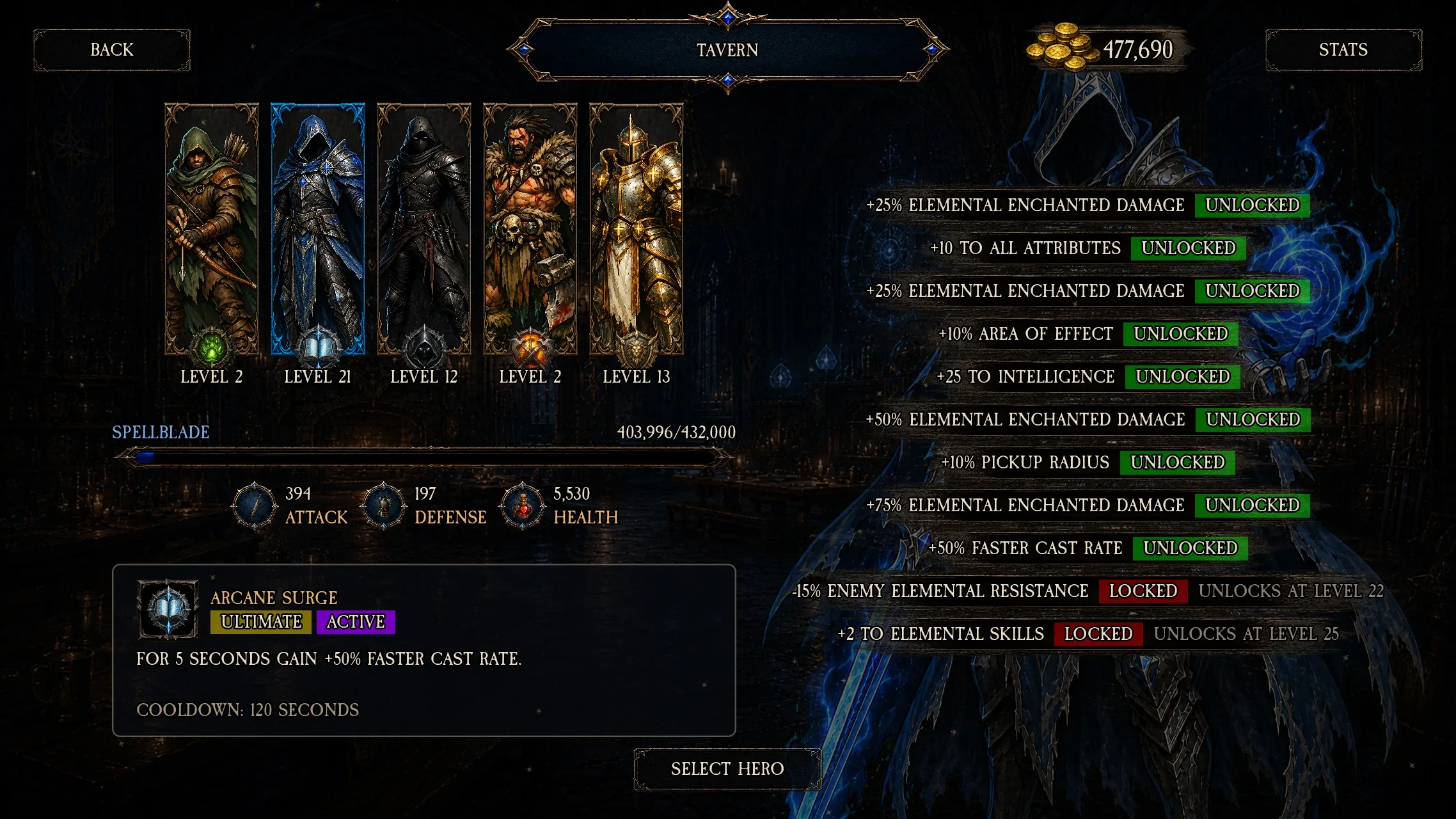
Paragon levels are long-term hero progression. They improve the hero over many real runs and help push higher levels, harsher modifiers, and stronger bosses.

Unlocking powers

As your account and heroes progress, new powers, bonuses, and build options become available. The tavern is where you review what a hero can do before the next descent.

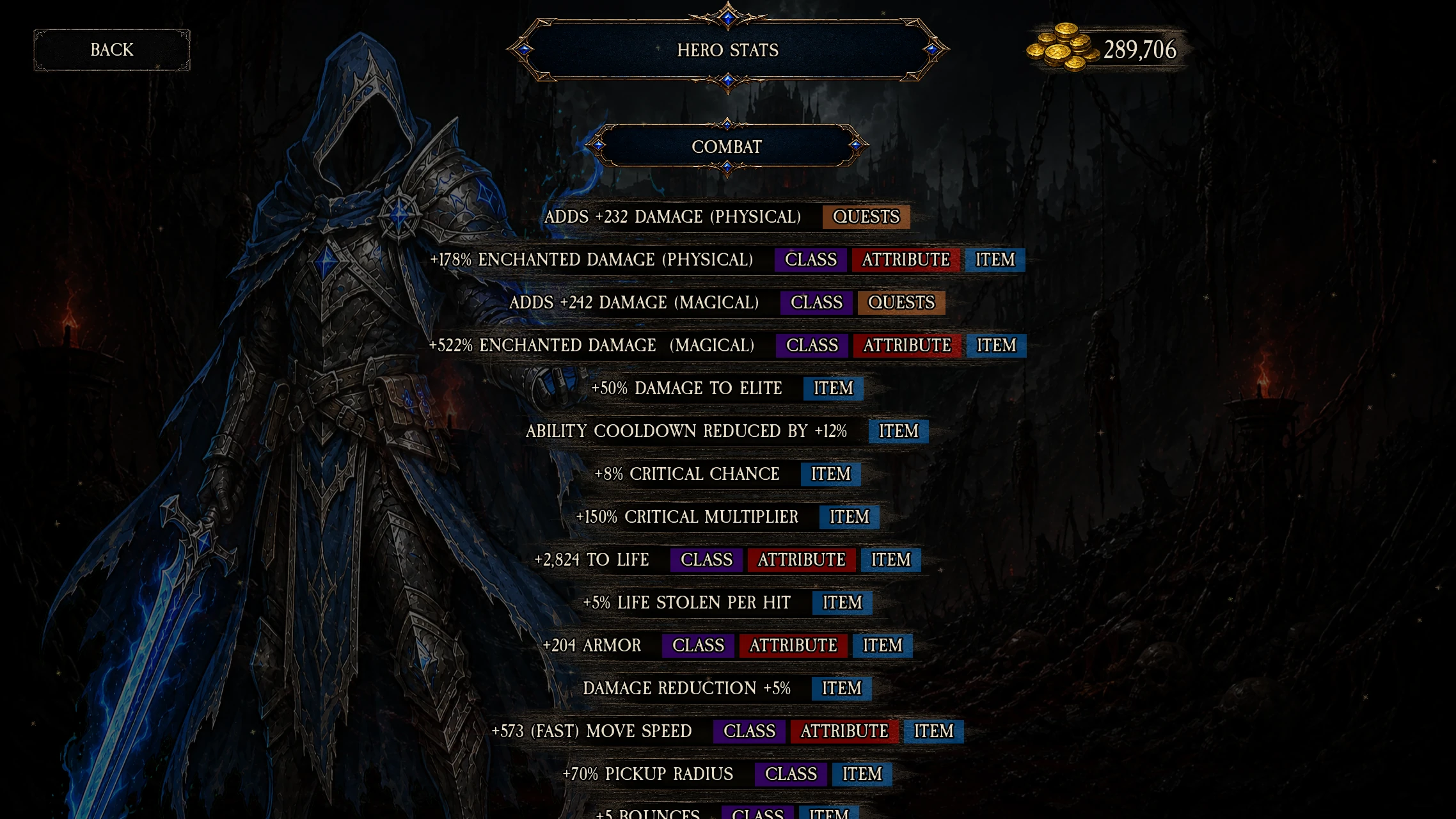
Total stats from all sources

The tavern lets you inspect combined stats from hero growth, gear, bonuses, and other systems. Use it to understand why one build feels strong and what your next upgrade should solve.

Check the Heroes page for hero identities, Disciplines, unlocks, stat growth, and class bonuses.

Ascension

Endgame leveling that resets power into deeper growth

Why Ascension matters

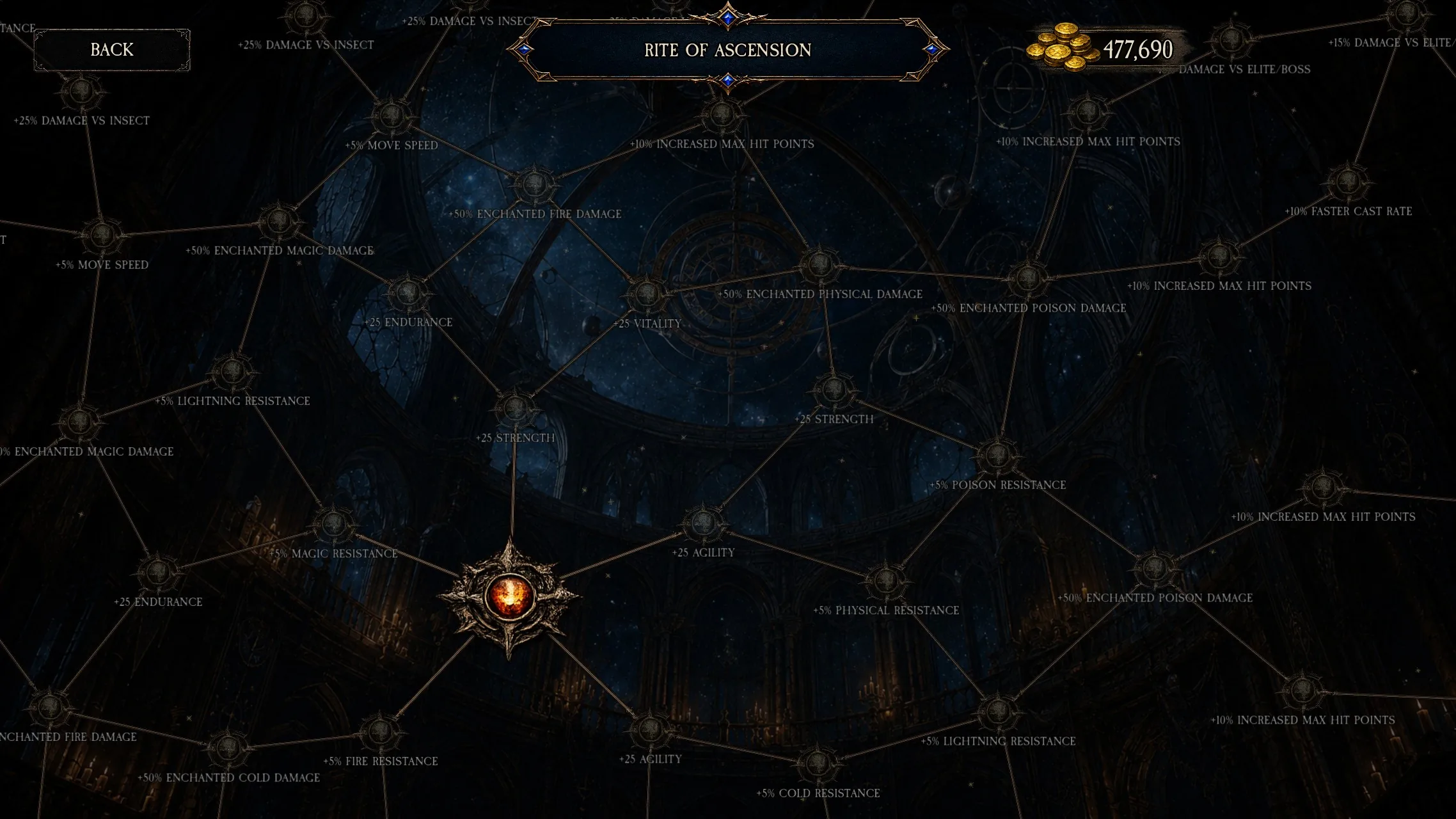
Ascension is an endgame progression layer for players who have pushed far enough that ordinary upgrades are no longer the whole story. It asks you to invest earned progress into a larger power curve, opening stronger long-term goals and giving late-game farming a clearer purpose.

Think of it as the system that turns repeated victories, collected trophies, and deep account investment into the next climb.

Trials of Veles

The endless ladder after the campaign ends

What the Trials are

Once you have cleared all 15 campaign levels — every level on Mortal, Broken, and Damned — the Trials of Veles open on the Crimson Rift at Damned difficulty. They are the grinding layer the campaign hands you when there is nothing left to unlock: the same arena, the same ten-minute contract, and an enemy power dial that never stops turning.

There are seventeen trials, numbered I through XVII, plus Unchallenged for a normal Damned run. You pick one before you start, and it applies only to the Crimson Rift on Damned — every other level and difficulty ignores it entirely.

1

Each trial raises enemy power

A trial adds a flat bonus to the base multiplier that scales enemy HP and damage. Trial I adds +5, Trial V adds +40, Trial X adds +150, and Trial XVII adds +1000. The jump between trials grows as you climb, so each rung asks for a genuinely stronger build rather than a slightly longer run.

2

Each trial pays more score

Score bonuses run from +25% at Trial I to +425% at Trial XVII, and they stack on top of your difficulty bonus, your active modifier bonus, and any Codex bonuses. If you care about the leaderboards, the trial you can reliably clear matters more than any single piece of gear.

3

You unlock them one at a time

A trial only opens once you have completed the trial before it. There is no skipping to Trial XVII because you feel ready — the ladder is strictly sequential, and your progress is saved per trial so you always know exactly where the wall is.

4

How to actually push a wall

When a trial stops falling, the answer is usually outside the run: upgrade equipment toward Epic, spend Hunter's Trophies in the Rite of Ascension, finish Compendiums for their permanent passives, and level the Veil modifiers you like fighting under. A trial you cannot clear today is a shopping list, not a dead end.

First Run Checklist

Simple rules that keep you alive

Still need help?

Ask the Veles community

Join the Discord server to ask gameplay questions, compare builds, find answers, report bugs, or suggest what we should improve next.

Get help on Discord